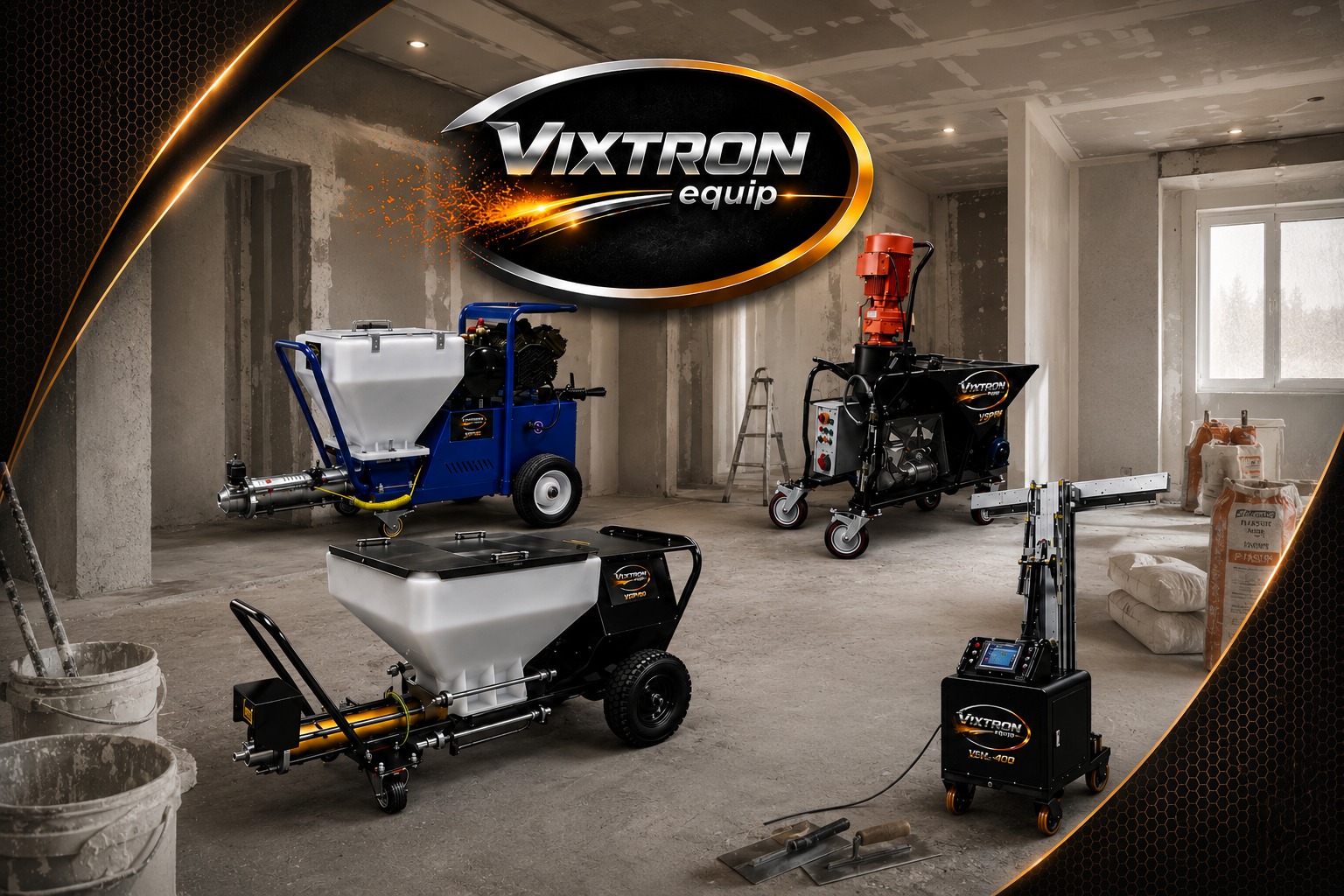
Choosing the right plaster spray machine is not a random decision, especially in construction and finishing projects across the UAE. Contractors work on different types of projects: villas, residential buildings, commercial towers, exterior façades, renovation work, interior finishing, and specialized surface applications. Each project has different requirements. Some jobs need a compact and easy-to-move machine, while others need a higher-output system that can operate continuously for long working hours. Some applications also require higher pressure to handle thicker materials or more demanding finishing layers.
Before buying a plaster spray machine, mortar spray machine, or wall levelling system, it is important to understand how these machines differ and which one is suitable for your material, project size, power supply, team capacity, and daily workflow.
This practical guide explains the key factors that help contractors choose the right plaster spray machine for their projects. It also compares VIXTRON models such as VSP18, VSP35, VHX30, and the VWL400 wall levelling system, so you can make a clearer purchasing decision before requesting a quotation.
Why Plaster Spray Machines Matter in Modern Finishing Projects
Traditional plastering has always depended heavily on manual application. While manual plastering is still used in smaller jobs and limited areas, modern construction projects require faster execution, more consistent application, better material control, and reduced dependency on fully manual work.
A plaster spray machine helps apply material faster and more evenly on walls or surfaces. It does not replace skilled workers. In fact, operator experience remains essential for preparing the surface, adjusting the material mix, selecting the right nozzle, controlling layer thickness, and ensuring a proper final result. However, the machine makes the process more organized and productive, especially in medium and large projects.
Using a plaster spray machine becomes especially useful when the project includes large wall areas, a tight delivery schedule, repeated daily application, or a need for a more consistent material distribution. It is also useful when working with ready-mix materials, mortar, plaster, texture coatings, or materials that require continuous pumping instead of repeated manual handling.
When Do You Need a Plaster Spray Machine Instead of Manual Application?
Not every project requires the same type of machine. In small repairs or limited finishing areas, manual application may be enough. But once the project size increases, the benefits of machine application become much clearer.
You may need a plaster spray machine when the wall area is large, when the project must be completed faster, when your team works across several sites, or when you want to reduce variation between different workers. A machine is also useful when the material needs consistent mixing, pumping, and spraying.
In the UAE construction market, time is a major factor. Delays in plastering and wall finishing can affect other stages such as painting, flooring, electrical works, HVAC, joinery, and final handover. Choosing the right machine from the beginning can help reduce delays and improve site productivity, especially for contractors managing several projects at the same time.
Key Factors to Consider Before Choosing a Plaster Spray Machine
Before looking at the model name or the price, you should define the technical and operational requirements of your project. These factors will determine whether you need a compact machine, a higher-output machine, a high-pressure solution, or an additional wall levelling system.
The first factor is the type of material. Are you working with cement plaster, mortar, ready-mix plaster, decorative texture, fillers, façade coatings, or high-viscosity materials? Each material behaves differently in terms of density, grain size, flow, and sprayability. Some machines are suitable for multiple light-to-medium materials, while others are designed for thicker materials or applications that require higher pressure.
The second factor is the output rate. For a small or medium project, you may not need the highest delivery capacity. But for larger projects or continuous daily operation, a higher output rate can improve productivity, as long as your team can keep up with the pace of spraying, levelling, cleaning, and quality control.
The third factor is pressure. Pressure affects how well the machine pushes the material through the hose and how stable the spray pattern remains during application. Some jobs require standard pressure, while others, especially high-viscosity materials or special coatings, need much higher pressure.
The fourth factor is grain size. If the material contains larger particles, the machine must be able to handle them without repeated blockage. Ignoring this point can lead to frequent stoppages and lower productivity.
The fifth factor is the power supply. Some sites provide 220V only, while others provide 380V. Before buying any machine, you must confirm the power supply available in your usual project locations. Choosing a machine that does not match the available electricity can create immediate operational problems.
The sixth factor is mobility and maintenance. Many contractors in the UAE move between multiple sites, so the machine should be practical to transport, clean, service, and maintain. A good machine is not only powerful; it must also be suitable for daily site use, with accessible spare parts and reliable technical support.
Comparison Between VSP18, VSP35, VHX30, and VWL400
To make the decision easier, let us compare four VIXTRON solutions. Each one serves a different need within plaster spraying, mortar spraying, high-pressure application, or wall levelling.
VSP18: A Practical Choice for Compact Projects and Multiple Materials
The VSP18 is suitable for contractors who need a practical and flexible solution for small-to-medium projects or jobs that require easy movement around the site. This type of machine is useful when you do not need the highest output rate, but you still need a machine capable of handling different materials efficiently.
One of the main advantages of this type of machine is that it helps smaller teams improve productivity without immediately investing in a larger machine that may exceed their actual requirements. If your work includes villas, residential units, renovation projects, decorative applications, or several medium-sized jobs, VSP18 can be a suitable starting point.
VSP18 makes sense if you are looking for a compact plaster spray machine that is easier to handle and suitable for work that does not require heavy continuous industrial operation every day.
VSP35: A Stronger Option for Medium and Large Projects
When a project requires higher productivity and longer working hours, a machine like VSP35 becomes more suitable. This type of machine is designed for contractors who handle larger projects, bigger teams, and higher daily output requirements.
VSP35 is suitable when the wall areas are large and you want to reduce the time needed for plaster or mortar application. It is also useful when the project has a tight schedule or when your team needs a machine that can support more intensive operation.
The difference between a compact machine and a higher-output machine is not only about specifications. It appears clearly in the site workflow. A stronger machine requires a team that can keep up with its output: preparing material, managing the spray process, levelling the surface, cleaning the system, and checking quality. For this reason, VSP35 is a strong option when your site team is ready to benefit from its higher capacity.
VHX30: For Higher Pressure and More Specialized Materials
Not all finishing materials are easy to pump or spray. Some materials are thicker, more viscous, or require higher pressure to achieve the desired application quality. This is where a machine like VHX30 becomes important.
VHX30 is suitable for applications that require higher pressure and more controlled material delivery. It can be relevant for façade coatings, fillers, high-viscosity materials, and certain specialized finishing applications where standard spraying systems may not be enough.
This type of machine is not necessarily the first choice for every contractor, but it becomes important when the material itself requires a stronger pressure system. Choosing a machine based only on price can create problems if the machine cannot properly handle the material. In such cases, the wrong machine may lead to blockage, weak spray performance, inconsistent results, and project delays.
VWL400: A Wall Levelling System, Not a Spray Machine
A common mistake is treating every plastering-related machine as if it performs the same function. VWL400 is not a plaster spray machine. It is a wall levelling system designed to help level and smooth the surface after plaster has been applied.
This distinction is important. In some projects, spraying the material is only one part of the process. After application, the surface still needs to be levelled properly to achieve better consistency and a cleaner final finish. A wall levelling system like VWL400 can help improve the final surface quality, especially when the project requires more accurate wall finishing.
If your goal is only to apply material faster, you may start by looking at a spray machine. But if your goal is to improve the full workflow from application to finishing, then VWL400 may be considered as a complementary system.
Which Machine Fits Your Project Type?
If you work on small-to-medium projects and need a flexible machine that is easy to move, VSP18 is usually the first model to consider. It is practical when the project size is not too large and when you need a machine that supports different types of materials and site conditions.
If you handle larger projects or need higher daily productivity, VSP35 is likely the stronger choice. It is more suitable for contractors with trained teams and continuous project demand.
If your materials are thick, high-viscosity, or require stronger pressure, VHX30 should be considered carefully. Choosing a lower-capacity machine for demanding materials may lead to poor performance and unnecessary site delays.
If your focus is not only spraying, but also improving surface quality and wall levelling after application, VWL400 can be added as part of a more complete finishing workflow.
Questions to Prepare Before Requesting a Quotation
Before asking for a recommendation or quotation, prepare a few key details. These details help the supplier or technical team recommend the right machine instead of giving a general answer.
First, what type of material will you use? Is it cement plaster, mortar, ready-mix plaster, decorative texture, filler, façade coating, or a high-viscosity material?
Second, what is the approximate project size or daily target area? The expected output helps determine the required machine capacity.
Third, what power supply is available on site? Do you have 220V or 380V? Is the power supply stable enough for continuous operation?
Fourth, how many workers or operators will work with the machine? A high-output machine needs a team that can follow the pace of spraying and finishing.
Fifth, do you need spraying only, or do you also need wall levelling and surface finishing after application?
Sixth, is the project internal or external? Are there façades, height requirements, restricted access areas, or special site conditions?
The clearer these details are, the more accurate the machine recommendation will be.
Common Mistakes When Buying a Plaster Spray Machine
One of the most common mistakes is choosing the machine based only on price. Price is important, but it should not be the only factor. A cheaper machine that does not match the material or project size can lead to repeated stoppages, higher maintenance costs, and wasted time.
The second mistake is ignoring material compatibility. Some contractors buy a machine and later discover that it does not work well with the material they use. This is why the machine must be matched with the material type, grain size, viscosity, and application method.
The third mistake is choosing a machine that is larger than needed. A larger machine can be excellent, but it is not always the right choice if the team is small or the projects are limited. In that case, you may pay more without fully benefiting from the machine’s capacity.
The fourth mistake is not considering maintenance and spare parts. Any machine used on construction sites will require cleaning, maintenance, and replacement of wear parts. For this reason, technical support and spare part availability are just as important as the machine specifications.
The fifth mistake is neglecting operator training. Even the best machine will not deliver the right result if the operator does not know how to use it properly. Training is important for pressure adjustment, material preparation, nozzle selection, cleaning, and safe operation.
How to Make the Decision Easier
You can simplify the decision as follows:
If you need a flexible machine for small-to-medium projects and different materials, start by considering VSP18.
If you need higher output and continuous operation for larger projects, consider VSP35.
If your material is high-viscosity or your application requires higher pressure, consider VHX30.
If you need to improve wall levelling and final surface quality after spraying, consider VWL400 as a complementary system.
The final decision should not depend only on the model name. The best approach is to share your project details, material type, required daily output, power supply, and working conditions before choosing the machine.
Final Recommendation
Choosing the right plaster spray machine can save significant time and cost in finishing projects, but the decision must be based on the actual project requirements. Not every machine fits every application, and not every contractor needs the largest or most powerful option.
Small and medium projects usually need flexibility and ease of use. Larger projects need higher productivity and continuous operation. High-viscosity materials need stronger pressure and better control. Wall finishing quality may also require a levelling system after spraying.
If you are working in the UAE and looking for the right plaster spray machine for your project, start by identifying your material, daily working area, available electricity, and team size. After that, you can choose between VSP18, VSP35, VHX30, and VWL400 based on your actual needs.
To receive an accurate recommendation, share your project details with the VIXTRON team and request technical guidance before purchasing.